


Hey there! As a supplier of syringe pumps, I've been getting a lot of questions lately about the flow rate stability of these nifty devices under different pressures. So, I thought I'd sit down and share some insights with you all.
First off, let's talk about what a syringe pump is. If you're not familiar, a syringe pump is a medical device that's used to deliver a precise amount of fluid over a set period of time. It's commonly used in hospitals, clinics, and other healthcare settings for things like administering medications, fluids, and nutrients to patients.
Now, when it comes to the flow rate stability of a syringe pump, it's all about how well the pump can maintain a consistent flow of fluid, regardless of the pressure it's operating under. You see, in a real-world healthcare scenario, the pressure inside a syringe pump can vary depending on a number of factors, such as the viscosity of the fluid being delivered, the length and diameter of the tubing, and the resistance of the patient's veins or arteries.
So, why is flow rate stability so important? Well, think about it. If a syringe pump can't maintain a stable flow rate, it could lead to inaccurate dosing of medications or fluids, which could have serious consequences for the patient. For example, if a patient is supposed to be receiving a certain amount of pain medication at a specific rate, but the pump is delivering it too quickly or too slowly, it could result in either under - or over - medication.
Let's dive into how different pressures can affect the flow rate stability of a syringe pump. When the pressure inside the pump increases, it can cause the flow rate to increase as well. This is because the higher pressure forces the fluid through the tubing more quickly. On the other hand, if the pressure decreases, the flow rate will typically decrease too.
One of the main challenges in maintaining flow rate stability under different pressures is dealing with the fluid's viscosity. Viscous fluids, like thick medications or blood products, are more resistant to flow than less viscous fluids, like water or saline. So, when a syringe pump is delivering a viscous fluid, it has to work harder to maintain a consistent flow rate, especially when the pressure changes.
Another factor that can impact flow rate stability is the tubing. If the tubing is too long or too narrow, it can create more resistance, which can affect the flow rate. Additionally, if the tubing is kinked or blocked, it can cause the pressure to fluctuate and disrupt the flow.
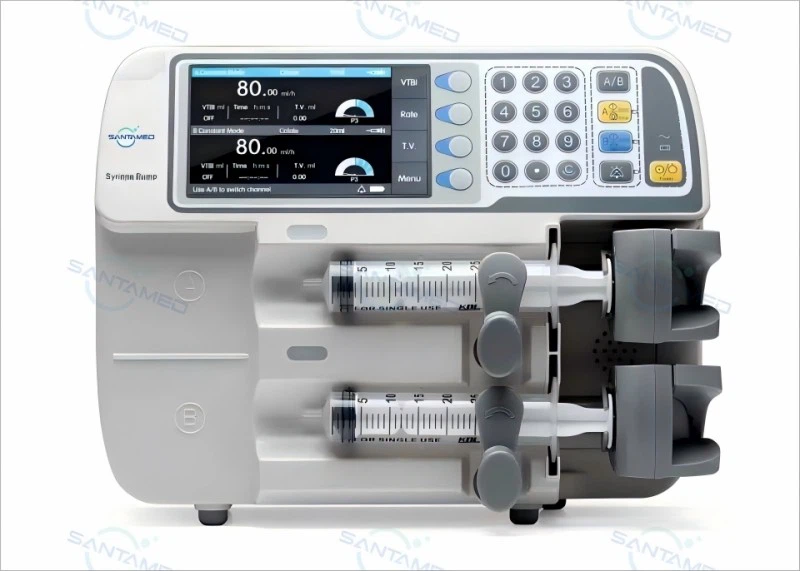
At our company, we've put a lot of effort into developing syringe pumps that offer excellent flow rate stability under a wide range of pressures. Our Medical Syringe Pump is designed with advanced technology that helps to compensate for changes in pressure. It uses sophisticated sensors and algorithms to monitor the flow rate in real - time and make adjustments as needed to ensure a stable and accurate delivery of fluids.
Our Portable Injection Syringe Pump is another great option. It's not only convenient for use in different healthcare settings, but it also maintains high flow rate stability. It's compact and lightweight, making it easy to move around, yet it's still powerful enough to handle various pressures and fluid viscosities.
To test the flow rate stability of our syringe pumps under different pressures, we conduct a series of rigorous experiments. We simulate different real - world scenarios, including changes in fluid viscosity, tubing length, and pressure. We measure the flow rate at regular intervals and compare it to the set rate to ensure that the pump is performing accurately.
In these tests, we've found that our pumps are able to maintain a flow rate accuracy of within a very small margin, even when the pressure varies significantly. This is thanks to the high - quality components and advanced control systems that we use in our products.
When it comes to choosing a syringe pump, it's important to look for one that offers good flow rate stability. You don't want to take any chances with inaccurate dosing, especially when it comes to the health and well - being of your patients.
If you're in the market for a syringe pump, whether it's for a large hospital or a small clinic, we'd love to talk to you. Our team of experts can help you choose the right pump for your specific needs and answer any questions you might have about flow rate stability or other features.
We understand that every healthcare facility has different requirements, and we're committed to providing you with the best possible solution. So, if you're interested in learning more about our syringe pumps and how they can benefit your practice, don't hesitate to reach out. We're here to assist you in making an informed decision and ensuring that you get a reliable and high - performance syringe pump.
In conclusion, flow rate stability under different pressures is a crucial aspect of syringe pump performance. Our syringe pumps are designed to meet the highest standards in this regard, offering accurate and consistent dosing in a variety of healthcare settings. Whether you need a medical syringe pump for a busy operating theater or a portable injection syringe pump for on - the - go use, we've got you covered.
If you're ready to take the next step and explore our range of syringe pumps, or if you just want to have a chat about your needs, we're here for you. Let's work together to ensure that your patients receive the best possible care with the help of our top - notch syringe pumps.

References
- "Principles of Medical Instrumentation" by John G. Webster
- "Medical Device Technology: Principles and Design" by David G. Gorman


